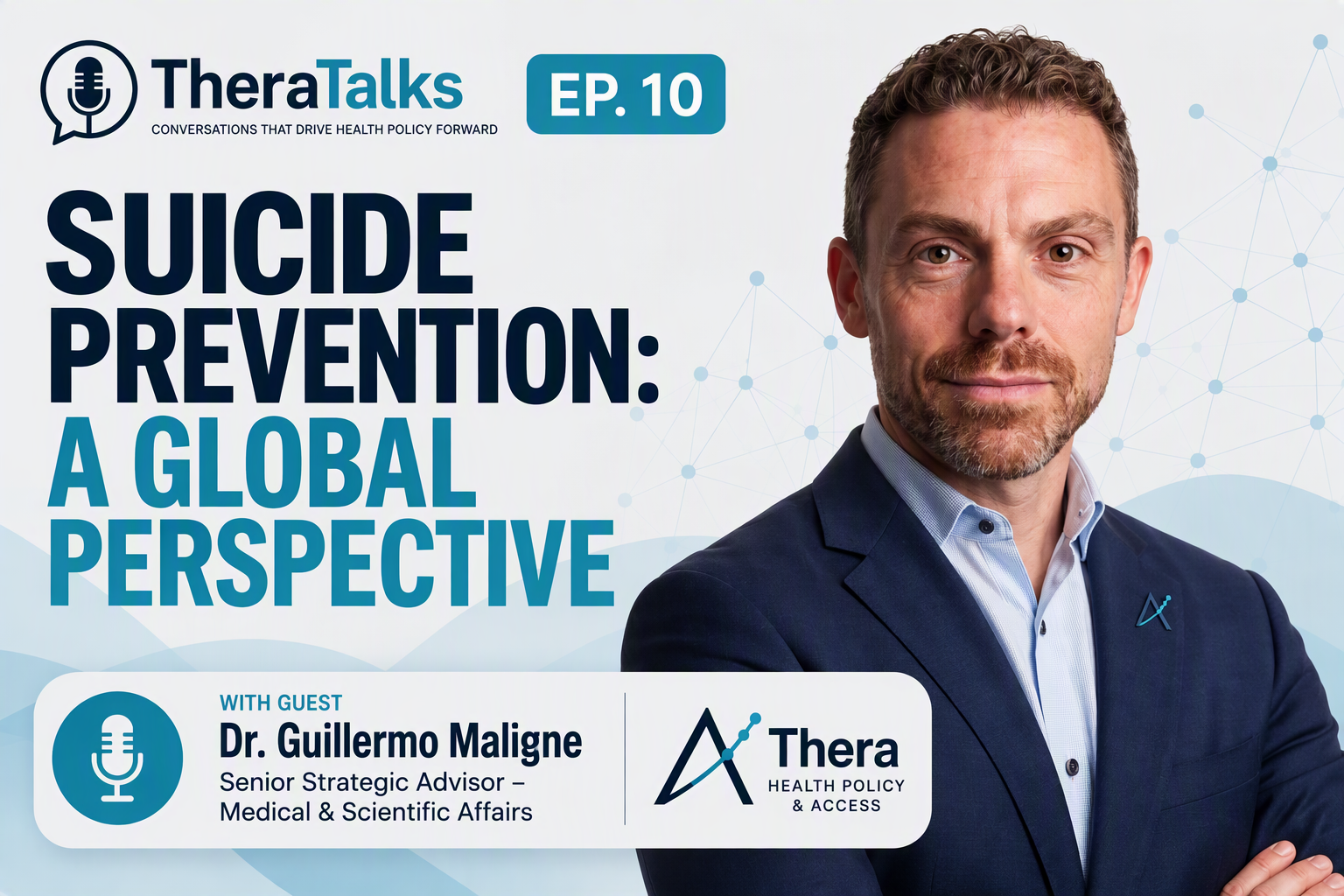
October 2026 – Suicide remains one of the most complex and urgent public health challenges facing societies worldwide. Preventing deaths by suicide requires more than access to mental health treatment. It also requires greater awareness, earlier recognition of warning signs, responsible communication, effective pathways to care, stronger health systems, and public policies capable of addressing the multiple factors that can place people at risk.
Against this backdrop, Thera Health Policy & Access is pleased to announce the release of Episode 10 of TheraTalks, its interview series bringing together healthcare leaders, policymakers, experts, and thought leaders to explore the issues shaping the future of healthcare and public health.
This latest episode features a conversation between José Luis Cárdenas Tomažič, Founder & Managing Director of Thera Health Policy & Access, and Dr. Guillermo Maligne, Senior Strategic Advisor – Medical & Scientific Affairs at Thera Health Policy & Access, focused on suicide prevention and the need to approach it from a comprehensive public health perspective.
A central message of the conversation is that suicide cannot be explained by a single cause.
Mental health conditions can be important risk factors, but suicide can also be associated with emotional distress, acute personal crises, social and economic circumstances, relationships, physical suffering, previous experiences, and other forms of vulnerability. Understanding how these factors interact is essential to designing more effective prevention strategies.
For Thera, this points to a fundamental public health challenge: suicide prevention cannot begin only when a person reaches a mental health service. It must also involve creating communities, institutions, and health systems capable of recognizing risk, opening conversations, and connecting people with appropriate support.
One of the most important themes addressed during the episode is the widespread misconception that speaking directly about suicide may introduce suicidal thoughts or increase the risk of suicidal behaviour.
José Luis and Guillermo discuss why responsible and direct communication can instead provide an opportunity for someone experiencing distress to express what they are going through. Asking, listening without judgement, remaining present, and facilitating access to professional support can all form part of an appropriate response.
The conversation therefore highlights the importance of recognizing warning signs.
Changes such as saying goodbye unexpectedly, putting personal affairs in order, giving away possessions, resolving outstanding matters, or expressing the belief that other people would be better off without them can indicate significant distress and should not simply be dismissed.
Recognizing a warning sign, however, is only the beginning.
The episode explores what families, friends, colleagues, communities, and healthcare professionals can do when they are concerned about someone. Listening, asking directly, accompanying the person, seeking professional assistance, and prioritizing safety when there is a significant risk are discussed as important components of an effective response.
José Luis and Guillermo also address the difficult question of confidentiality. When someone experiencing a crisis asks another person not to tell anyone, those close to them may face a difficult decision. The conversation emphasizes that when there is a significant risk to life, safety and access to appropriate support must take priority.
The discussion then moves beyond the individual response toward the broader responsibilities of health systems and public policy.
Effective suicide prevention requires better information and surveillance, appropriate training across healthcare services, accessible mental health care, public education, clearly defined pathways to support, responsible communication, reduced stigma, and continued research.
These dimensions are particularly important because suicide is not simply a clinical phenomenon. Social, cultural, economic, institutional, and healthcare factors can all influence vulnerability as well as the ability of individuals to receive timely support.
From this perspective, suicide prevention becomes a whole-of-system public health challenge.
Health systems need the capacity not only to respond to acute crises, but also to recognize risk earlier and ensure that people can move effectively from the identification of a problem to appropriate care. At the same time, communities need the knowledge and confidence to recognize situations of concern and understand when and how to seek help.
Another important theme explored in the episode is stigma.
Misconceptions about suicide and mental health can prevent people from speaking openly about distress and can make it more difficult for families, friends, and colleagues to respond appropriately. Treating expressions of suicidal ideation simply as attempts to attract attention can be particularly harmful.
Instead, the conversation argues for a more informed culture in which indications of distress are taken seriously and people feel able to speak openly and seek assistance without judgement.
This also requires responsible language.
José Luis and Guillermo reflect on the importance of discussing deaths by suicide as a public health issue, avoiding judgemental explanations and resisting the temptation to attribute an individual death to a single cause.
For Thera, the implications extend beyond mental health services themselves. Suicide prevention requires connecting health policy, education, community awareness, data, service delivery, professional training, research, and social support.
The challenge is therefore not simply to raise awareness, but to transform awareness into the ability to respond.
This means ensuring that healthcare professionals know how to identify and manage risk, that individuals and communities understand warning signs, that appropriate services are accessible when needed, and that public policy creates an environment in which prevention is treated as a sustained health priority.
Reflecting on the conversation, José Luis highlighted this broader challenge:
“Suicide prevention cannot be the responsibility of mental health services alone. We need health systems and societies that are better prepared to recognize when someone may be at risk, to listen without judgement, and to connect people with support. Talking about suicide responsibly is not the problem. Silence, stigma, and the inability to recognize and respond to suffering are part of the challenge we need to address.”
The discussion ultimately leaves an important question for policymakers, healthcare leaders, professionals, families, and communities: how can we move from greater awareness about suicide to prevention systems capable of recognizing risk earlier and responding effectively when someone needs help?
Suicide Prevention: A Global Public Health Challenge
Watch the full episode on YouTube
Dr. Guillermo Maligne is Senior Strategic Advisor – Medical & Scientific Affairs at Thera Health Policy & Access, contributing medical and scientific expertise to the firm’s work and strategic discussions.
In this episode of TheraTalks, Dr. Maligne brings a medical and scientific perspective to the discussion around suicide prevention, examining risk, early recognition, communication, prevention, and the importance of approaching the issue from an integrated public health perspective.
Thera Health Policy & Access is a specialized consultancy and Think & Do Tank focused on health policy, market access, healthcare regulation, public affairs, strategic intelligence, and healthcare system transformation.
Through evidence-based analysis, stakeholder engagement, and multidisciplinary expertise, Thera supports organizations in navigating complex healthcare environments and advancing sustainable solutions that improve patient access and health outcomes.
Important note: This episode discusses suicide and suicidal ideation. The conversation is intended for educational and public health purposes and does not replace professional medical or mental health advice. If you or someone you know is experiencing suicidal thoughts or may be in immediate danger, please contact local emergency services, a crisis support service, or a qualified healthcare professional.