October 2026 – After more than two decades of biosimilar regulatory experience, the central challenge is increasingly shifting from demonstrating the science behind biosimilars to ensuring that healthcare systems translate regulatory progress and competition into broader and more sustainable patient access.
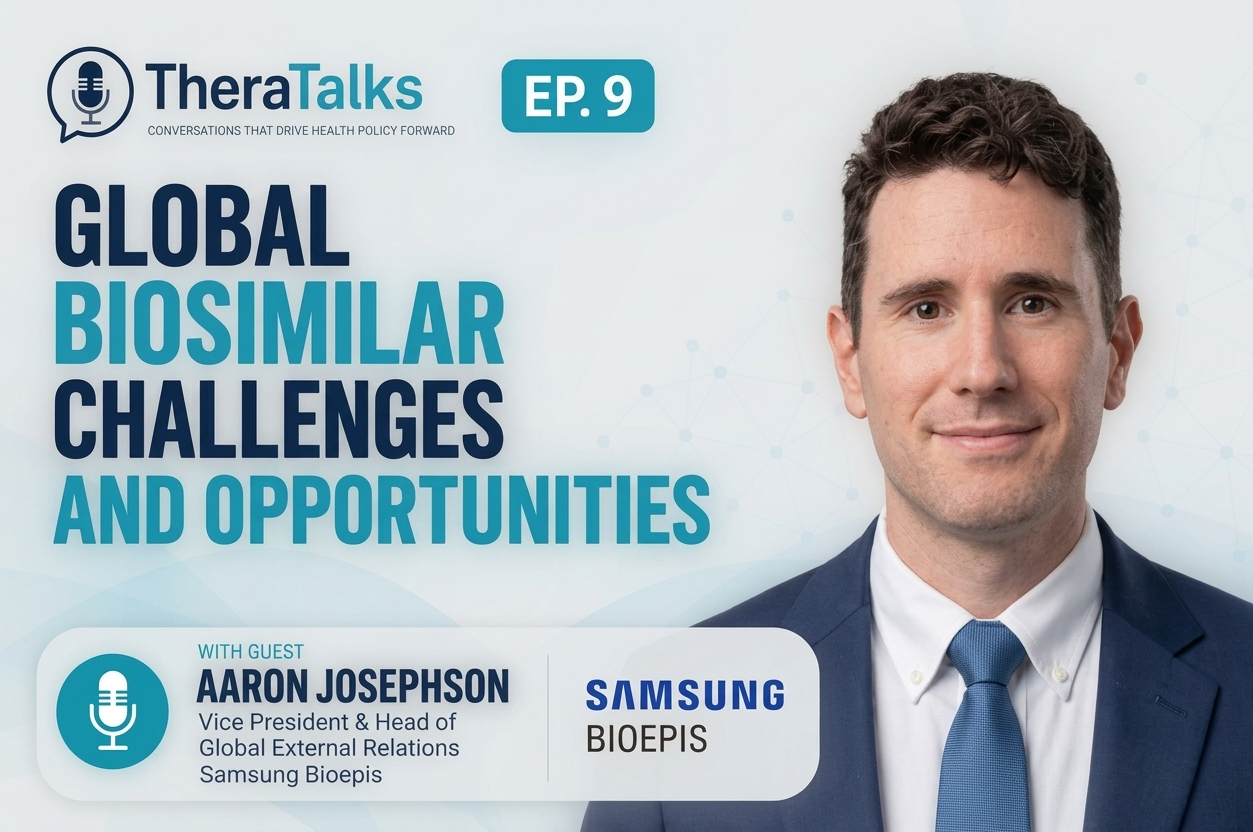
Against this backdrop, Thera Health Policy & Access is pleased to announce the release of Episode 9 of TheraTalks, its interview series bringing together healthcare leaders, policymakers, regulators, industry experts, and thought leaders to explore the issues shaping the future of healthcare in Latin America and beyond.
This latest episode features a conversation between José Luis Cárdenas Tomažič, Founder & Managing Director of Thera Health Policy & Access, and Aaron Josephson, Vice President & Head of Global External Relations at Samsung Bioepis, one of the world’s leading biosimilar companies.
As the global healthcare community prepares to celebrate Global Biosimilars Week 2026, the conversation reflects on more than two decades of progress in biosimilars and explores what must come next to translate scientific and regulatory advances into meaningful benefits for patients and healthcare systems.
Biosimilars have become an increasingly important component of healthcare systems worldwide, creating opportunities to expand access to biologic therapies while supporting competition and long-term health system sustainability. Yet significant challenges remain. Regulatory fragmentation, uneven adoption, differences in national policies, and varying levels of stakeholder confidence continue to influence the extent to which healthcare systems capture the potential benefits of biosimilar competition.
For Thera, this points to an important evolution in the biosimilar policy agenda: the next chapter will increasingly be defined not only by regulatory science, but by the capacity of healthcare systems to translate regulatory maturity into effective competition, stakeholder confidence, and broader patient access.
A central theme of the conversation is the evolution of biosimilar regulatory science. José Luis and Aaron explore how regulatory frameworks have developed as authorities around the world have accumulated scientific evidence and practical experience with biosimilar development, approval, and use.
The discussion also examines the significance of the World Health Organization’s 2022 Guidelines on Biosimilars and their role in supporting regulatory convergence and strengthening confidence in biosimilar development and approval standards globally.
Particular attention is given to regulatory reliance, convergence, and international cooperation. Aaron discusses the progress achieved to date, as well as the practical barriers that continue to limit broader adoption of these approaches. The conversation considers how greater alignment among regulatory authorities could reduce unnecessary duplication and accelerate access to high-quality biologic medicines while maintaining rigorous standards of quality, safety, and efficacy.
Another important theme is the potential for single global development programs. As regulatory science and experience with biosimilars continue to mature, José Luis and Aaron discuss the opportunities associated with more globally aligned development requirements and what greater convergence could mean for development efficiency, regulatory processes, and ultimately patient access.
These questions are particularly relevant for Latin America, where countries continue to develop their own regulatory, procurement, reimbursement, and biosimilar adoption frameworks. From a regional perspective, international regulatory convergence and reliance therefore matter beyond regulatory efficiency: they can influence how healthcare systems create the conditions for biosimilar competition to translate into meaningful patient access.
The episode also examines one of the most persistent challenges facing biosimilar policy: the gap between regulatory approval and real-world adoption.
Despite the strong body of evidence supporting biosimilars, uptake remains highly variable across countries, healthcare systems, therapeutic areas, and clinical settings. José Luis and Aaron discuss the institutional, economic, clinical, and behavioural factors that can influence adoption, including policy frameworks, procurement and reimbursement mechanisms, clinical practice, stakeholder confidence, and patient perceptions.
This leads to a broader question explored throughout the episode: what happens after regulatory approval?
Approval alone does not ensure that biosimilar competition will translate into expanded access. Capturing its full potential requires coordinated action across the healthcare ecosystem, involving regulators, policymakers, healthcare providers, payers, industry stakeholders, and patient organisations.
The conversation therefore highlights the importance of building stakeholder confidence. Scientific evidence and strong regulatory standards provide the foundation for the biosimilar pathway, but successful implementation also depends on healthcare professionals, patients, policymakers, and institutions understanding and having confidence in that pathway.
From this perspective, biosimilar policy becomes increasingly a health system issue rather than solely a regulatory question. Regulatory frameworks, competition, procurement, reimbursement, clinical practice, stakeholder engagement, and access policies ultimately interact in determining whether biosimilars generate sustainable value for healthcare systems and meaningful benefits for patients.
Looking ahead, José Luis and Aaron reflect on the role that biosimilars can play in the long-term sustainability of healthcare systems. As demand for biologic therapies continues, effective biosimilar competition may offer healthcare systems an opportunity not only to manage expenditure, but also to expand access to biologic treatments and enable more patients to benefit from advances in medicine.
The discussion ultimately points towards an important transition for the global biosimilars ecosystem: from regulatory maturity towards policy and health system maturity.
The scientific and regulatory foundations for biosimilars have strengthened considerably over the past two decades. The next challenge is to ensure that regulatory convergence, international cooperation, effective competition, stakeholder confidence, and coherent access policies work together so that this progress translates into tangible improvements in patient access and health system sustainability.
Reflecting on the discussion, José Luis highlighted this broader policy challenge:
“After more than two decades of regulatory experience, the conversation around biosimilars is increasingly shifting from whether the science works to how healthcare systems can translate that scientific and regulatory maturity into sustainable patient access. Regulatory convergence, effective competition, stakeholder confidence, and coherent access policies will all be critical if we want biosimilars to achieve their full potential for patients and health systems.”
As biosimilar regulatory science continues to mature, an important question emerges for policymakers and healthcare leaders worldwide: what policy, procurement, reimbursement, and stakeholder strategies are now needed to ensure that regulatory progress translates into broader and sustainable patient access?
https://www.youtube.com/watch?v=y95wm9kQ5aA
Aaron Josephson is Vice President & Head of Global External Relations at Samsung Bioepis, where he leads global public policy, government affairs, regulatory policy, and stakeholder engagement initiatives supporting patient access to biologic and biosimilar medicines worldwide.
Prior to joining Samsung Bioepis, Aaron served as Senior Director, Global Policy and Head of U.S. Regulatory Policy & Intelligence at Teva Pharmaceuticals. Earlier in his career, he spent more than a decade at the U.S. Food and Drug Administration (FDA), including serving as Senior Policy Advisor, where he contributed to regulatory and legislative initiatives affecting biologics, biosimilars, and healthcare innovation.
His work included contributions to the 21st Century Cures Act and FDA user fee reauthorization initiatives.
Aaron holds a Master of Science in Regulatory Science from Johns Hopkins University and a Bachelor of Arts in Political Science from the University of Virginia.
Thera Health Policy & Access is a specialized consultancy and Think & Do Tank focused on health policy, market access, healthcare regulation, public affairs, strategic intelligence, and healthcare system transformation.
Through evidence-based analysis, stakeholder engagement, and multidisciplinary expertise, Thera supports organizations in navigating complex healthcare environments and advancing sustainable solutions that improve patient access and health outcomes.