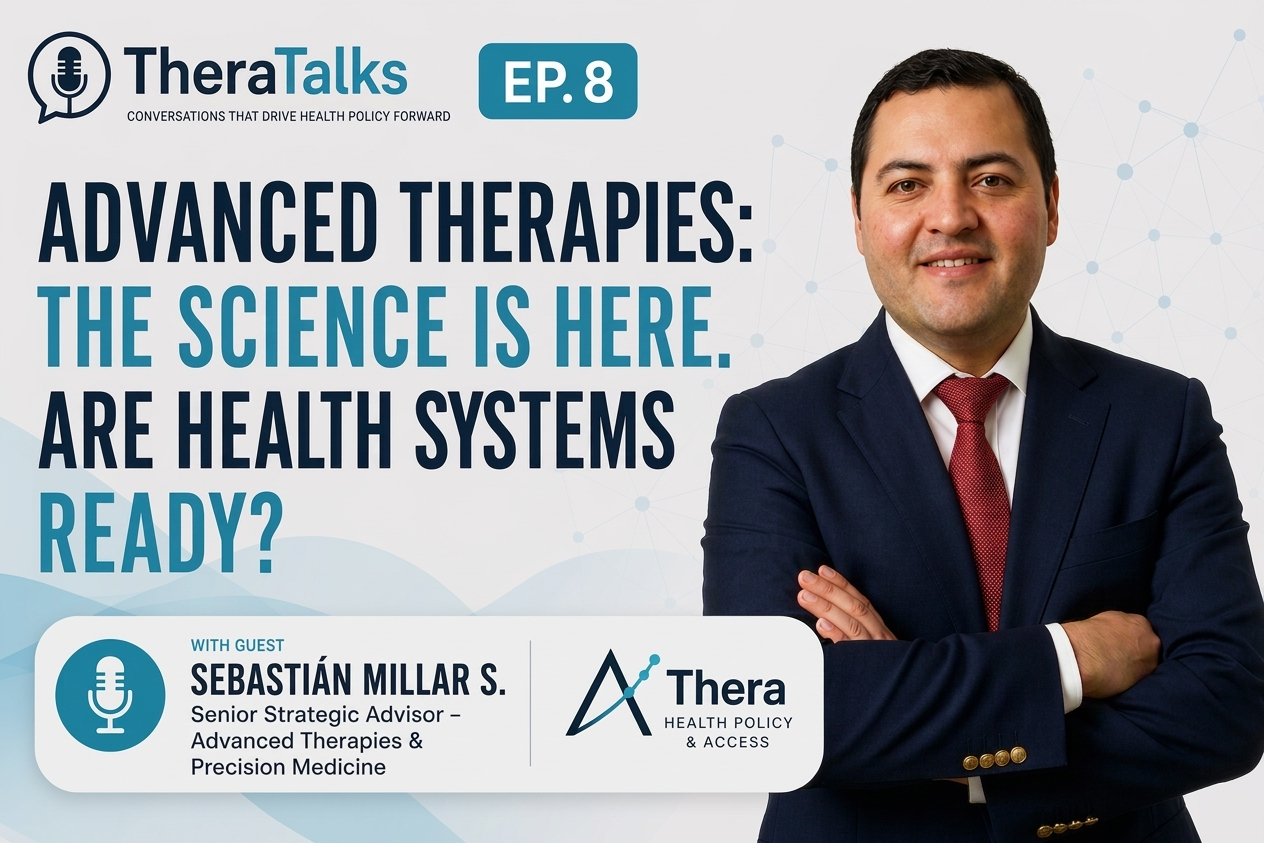
September 30, 2026 – Thera Health Policy & Access is pleased to announce the release of Episode 8 of TheraTalks, the interview series dedicated to engaging healthcare leaders, policymakers, regulators, industry innovators, and thought leaders in meaningful conversations about the issues shaping the future of healthcare in Latin America and beyond.
This latest episode features a conversation between José Luis Cárdenas Tomažič, Founder & Managing Director of Thera Health Policy & Access, and Sebastián Millar S., Senior Strategic Advisor for Advanced Therapies & Precision Medicine at Thera Health Policy & Access.
As scientific advances continue to transform medicine, healthcare systems around the world are confronting a new challenge: ensuring that breakthrough innovations translate into real-world patient access and meaningful health outcomes. In this episode, José Luis and Sebastián explore the opportunities and challenges associated with precision medicine, advanced therapies, health system readiness, and equitable access to innovation.
A central theme of the discussion is the distinction between precision medicine and advanced therapies. Sebastián explains how precision medicine uses clinical, molecular, and genomic information to guide prevention, diagnosis, and treatment decisions tailored to individual patients, while advanced therapies encompass innovative modalities such as gene therapies, somatic cell therapies, tissue-engineered products, and CAR-T therapies. Together, these innovations have the potential to transform care for conditions that previously had limited therapeutic options.
The conversation highlights the growing importance of designing healthcare systems capable of supporting these therapies throughout the entire patient journey. While scientific advances often receive significant attention, Sebastián argues that diagnosis, patient identification, infrastructure, clinical capacity, financing, and long-term monitoring are equally critical to ensuring successful implementation and equitable access.
A significant portion of the interview focuses on the challenge of institutional fragmentation. The speakers discuss how different organizations frequently assume responsibility for regulatory approval, health technology assessment, financing, care delivery, and outcome monitoring. While each function may operate effectively in isolation, the absence of coordination can delay access and create barriers for patients seeking innovative therapies.
The discussion also examines the unique financing and implementation challenges associated with advanced therapies. Unlike conventional treatments, many advanced therapies require significant upfront investment while generating benefits over extended periods. José Luis and Sebastián explore how healthcare systems may need to adopt new approaches to risk-sharing, long-term outcome evaluation, and coverage design to manage uncertainty while ensuring sustainability.
Another important topic explored is the role of diagnostics and patient identification in healthcare access. Sebastián emphasizes that financing a therapy alone is insufficient if healthcare systems cannot reliably identify eligible patients or ensure that they receive timely diagnosis. The speakers discuss how gaps in screening programs, genomic testing, specialized clinical expertise, and treatment infrastructure can limit the real-world impact of innovative therapies.
The conversation also explores international experiences and lessons from Germany, Spain, the United Kingdom, and Brazil. Sebastián highlights how these countries have developed advanced therapy ecosystems through national strategies, regulatory leadership, clinical networks, technology transfer initiatives, capacity-building programs, and collaboration among government, industry, academia, healthcare providers, and patient organizations.
Particular attention is given to Germany’s national approach to advanced therapies, which seeks to coordinate stakeholders across the healthcare ecosystem rather than addressing implementation challenges in isolation. The discussion examines how strategic planning, long-term investment, and multi-stakeholder collaboration can create more favorable conditions for the development and adoption of innovative medicines.
The episode further addresses the implications of the World Health Organization’s ongoing efforts to develop a global strategy on precision medicine and advanced therapies, expected in 2029. In response to this evolving international agenda, Sebastián identifies three priorities for Latin America: mapping national capabilities and clinical pathways, designing access as a complete patient journey, and strengthening regional and international cooperation.
The speakers also discuss the importance of building regional expertise and fostering collaboration across countries. Given the complexity of advanced therapies and the relatively small patient populations associated with many conditions, Sebastián suggests that Latin American countries may benefit from sharing regulatory experiences, clinical protocols, research capabilities, and implementation lessons rather than approaching these challenges independently.
The role of patient organizations emerges as another key theme throughout the conversation. José Luis and Sebastián argue that patients should be viewed not merely as recipients of care, but as active participants in healthcare decision-making and policy development. They emphasize the importance of strengthening patient organizations and ensuring that patient perspectives are incorporated into the design of future access frameworks.
Reflecting on the discussion, José Luis emphasized that the challenge facing healthcare systems is no longer limited to scientific innovation.
“The science is advancing at an extraordinary pace. The question today is not whether these therapies can transform patients’ lives. The real question is whether our healthcare systems are prepared to identify the right patients, coordinate care, finance innovation responsibly, and deliver equitable access. Health system readiness may ultimately be the most important determinant of whether scientific breakthroughs achieve their full societal value.”
https://youtu.be/Fu8OJU63LOc?si=x2scsm1bPpismGrv
Sebastián Millar S. is a healthcare policy and market access expert with extensive experience in healthcare regulation, advanced therapies, precision medicine, public policy, and healthcare innovation. Throughout his career, he has worked across government, healthcare institutions, industry, and international collaborations, supporting the responsible adoption of innovative technologies and the development of policies that improve patient access to care.
As Senior Strategic Advisor for Advanced Therapies & Precision Medicine at Thera Health Policy & Access, he advises organizations on emerging therapeutic innovations, access strategies, regulatory developments, and healthcare system preparedness for the next generation of medical technologies.
Thera Health Policy & Access is a specialized consultancy and Think & Do Tank focused on health policy, market access, healthcare regulation, public affairs, strategic intelligence, and healthcare system transformation. Through evidence-based analysis, stakeholder engagement, and multidisciplinary expertise, Thera supports organizations in navigating complex healthcare environments and advancing sustainable solutions that improve patient access and health outcomes.