July 17, 2026
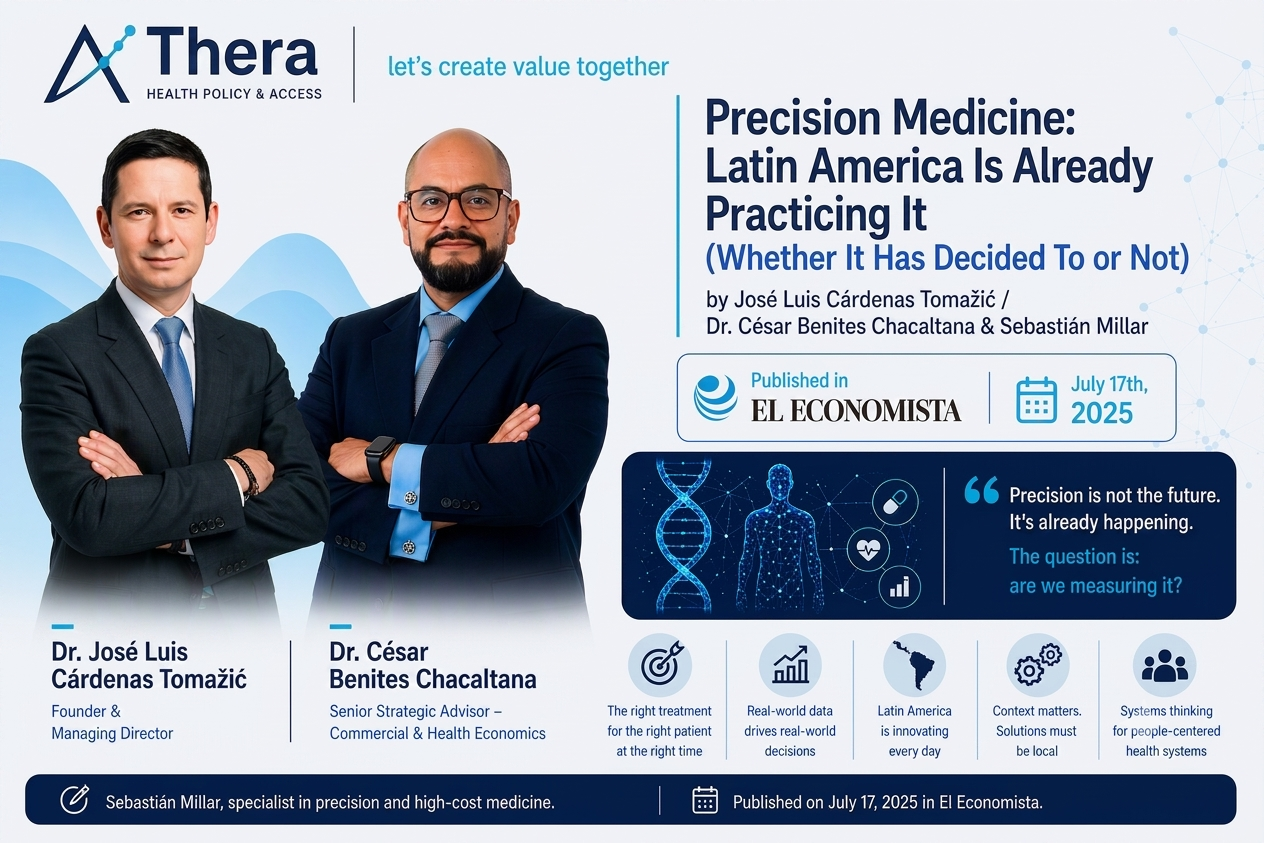
Thera Health Policy & Access is pleased to announce the publication of the opinion article “Precision Medicine: Latin America Is Already Practicing It (Whether It Has Decided To or Not)”, authored by José Luis Cárdenas Tomažič, Dr. César Benites Chacaltana, and Sebastián Millar. The article is an English adaptation of the column originally published in El Economista on July 17, 2026.
The piece explores the growing relevance of precision medicine in Latin America following the adoption of the World Health Assembly Resolution EB158.R2, “Precision Medicine: A Path Towards Targeted, Personalized and Equitable Care,” approved in Geneva in May 2026. The resolution establishes a roadmap for the World Health Organization (WHO) and member states to advance precision medicine through readiness assessments, international cooperation, and the development of a global strategy expected by 2029.
The authors argue that precision medicine is no longer a future aspiration for the region. In practice, it is already embedded in healthcare systems through reimbursement and coverage policies that require molecular, genetic, or biomarker-based diagnoses before patients can access specialized therapies. Examples discussed include Chile’s Ricarte Soto Law, Brazil’s genomic initiatives, Mexico’s longstanding investments in genomic medicine through INMEGEN, and regional efforts to strengthen health technology assessment and access frameworks.
The article highlights a critical paradox facing many Latin American countries: while access to innovative therapies increasingly depends on diagnostic confirmation, healthcare systems often fail to finance diagnostic testing with the same level of commitment. According to the authors, this disconnect risks widening inequalities, increasing litigation, and undermining the efficiency gains that precision medicine promises to deliver.
Beyond the clinical dimension, the article emphasizes the economic value of precision medicine. Targeted therapies supported by accurate diagnostics can improve resource allocation, reduce adverse events, shorten diagnostic journeys, and help healthcare systems avoid spending on treatments unlikely to benefit patients. The authors also underline the importance of newborn screening programs as one of the most equitable and cost-effective forms of precision medicine available to governments.
The publication identifies four strategic priorities for the region:
The article concludes that Latin America has already entered the precision medicine era. The challenge now is not whether to adopt it, but whether countries will build the institutional, regulatory, and financing capabilities required to capture its benefits equitably and sustainably.
As WHO and PAHO advance the implementation of the new global agenda, the authors call on governments across the region to undertake comprehensive readiness assessments and develop concrete action plans before the first international progress review in 2027.
Read the original publication in El Economista:
Medicina de precisión: América Latina ya la está practicando (aunque no lo haya decidido)
English version: Precision Medicine: Latin America Is Already Practicing It (Whether It Has Decided To or Not) – El Economista – Thera
Infographic: Precision Medicine – Thera
Authors:
José Luis Cárdenas Tomažič / Dr. César Benites Chacaltana & Sebastián Millar
Category: Health Policy | Precision Medicine | Genomics | Market Access | Latin America