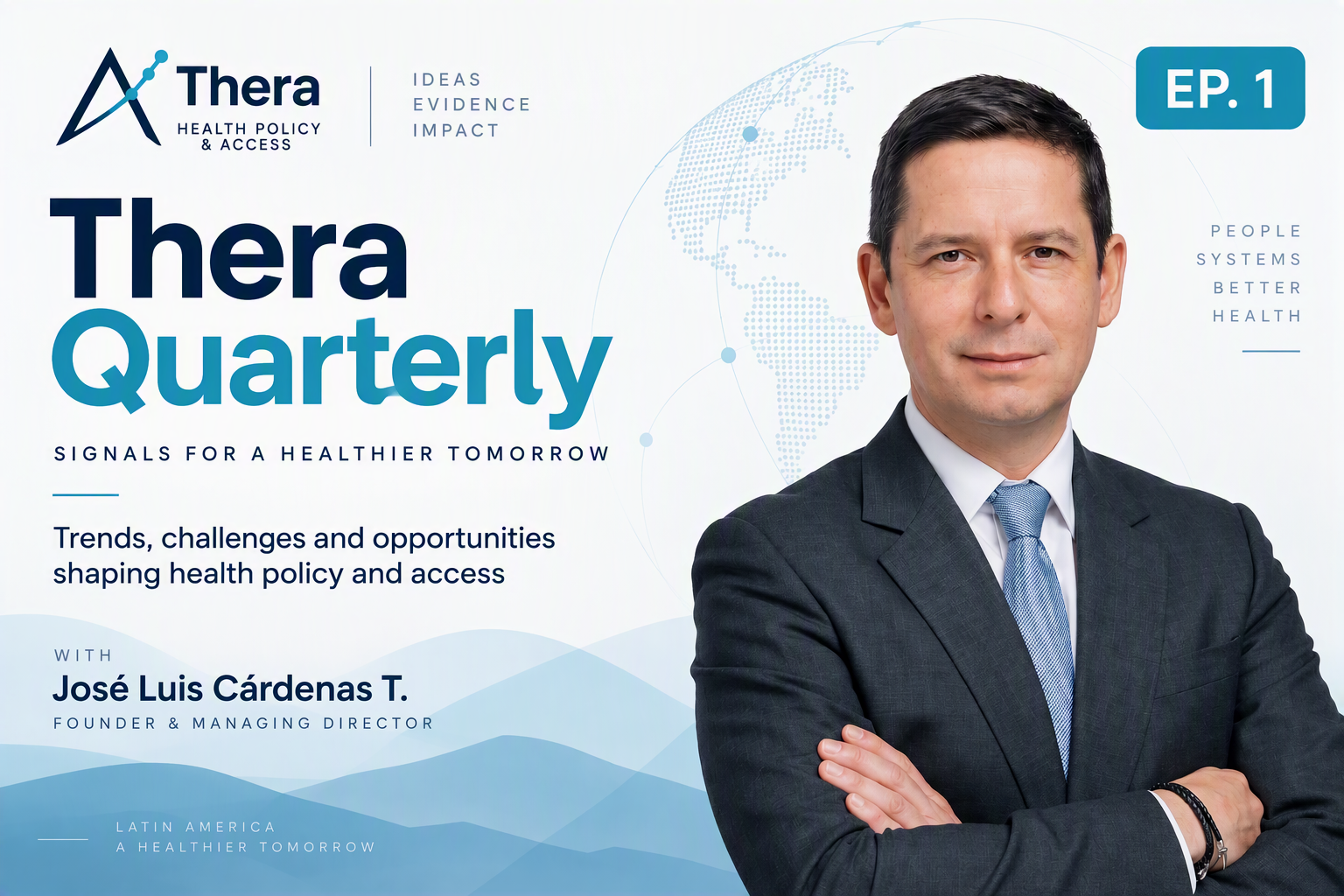
October 5, 2026 – Thera Health Policy & Access is pleased to announce the launch of Thera Quarterly, a new thought leadership series designed to explore the strategic trends, emerging signals, and structural challenges shaping healthcare systems around the world.
The inaugural episode, “The Implementation Gap,” is presented by José Luis Cárdenas Tomažič, Founder & Managing Director of Thera Health Policy & Access. The episode examines a growing paradox facing healthcare systems globally: while scientific innovation continues to advance at an unprecedented pace, many health systems struggle to translate those breakthroughs into meaningful improvements in patient outcomes.
The central thesis of the episode is straightforward but increasingly important: healthcare does not have an innovation shortage. It has an institutional adaptation problem.
Drawing on developments observed across multiple healthcare systems, José Luis identifies three signals that illustrate why implementation, rather than innovation itself, may become the defining challenge of the next decade.
The first signal highlights how access often begins long before reimbursement decisions are made. While coverage and financing remain important components of access, healthcare systems must also ensure that patients are identified, diagnosed, referred, and connected to appropriate care pathways. Even when effective therapies are available, weaknesses in diagnosis, patient identification, provider capacity, or care coordination can prevent innovation from reaching those who could benefit most.
The second signal explores the challenge of misaligned incentives and fragmented budgets. In many cases, the value generated by an innovation is realized in a different part of the healthcare system than the one responsible for paying for it. A technology may reduce long-term hospitalizations, disability, or productivity losses, yet the initial investment is often assessed within a much narrower budgetary framework. This disconnect can create barriers to adoption even when innovations generate substantial societal value.
The third signal focuses on the distinction between technology adoption and technology implementation. Healthcare organizations frequently invest in equipment, digital tools, and innovative therapies without developing the institutional capabilities required to use them effectively. Infrastructure, workforce skills, governance, maintenance, operational processes, and long-term sustainability are often as important as the technology itself in determining whether investments produce meaningful outcomes.
Together, these signals point toward a broader conclusion: scientific breakthroughs alone do not generate health outcomes. Institutions, capabilities, and implementation pathways ultimately determine whether innovation creates real-world impact.
The episode draws upon examples from recent scientific literature and global healthcare experiences, including research on cardiovascular outcomes associated with obesity treatment and studies examining the sustainability and utilization of medical equipment within healthcare systems. These examples illustrate how the success of innovation frequently depends on factors beyond the technology itself.
Reflecting on the episode’s central message, José Luis noted:
“The next access divide may not be between healthcare systems that have innovation and those that do not. It may be between those capable of converting innovation into better health outcomes, and those that are not. Innovation remains essential, but implementation capability may become the most important competitive advantage for healthcare systems in the years ahead.”
Through Thera Quarterly, Thera aims to provide strategic reflections on the trends influencing healthcare policy, market access, health system transformation, innovation adoption, and the evolving relationship between science, institutions, and patient outcomes.
Future episodes will continue to explore the signals shaping healthcare globally, with a particular focus on the implications for policymakers, healthcare providers, industry leaders, patient organizations, and other stakeholders working to improve health system performance.
Watch Thera Quarterly – Episode 1: The Implementation Gap