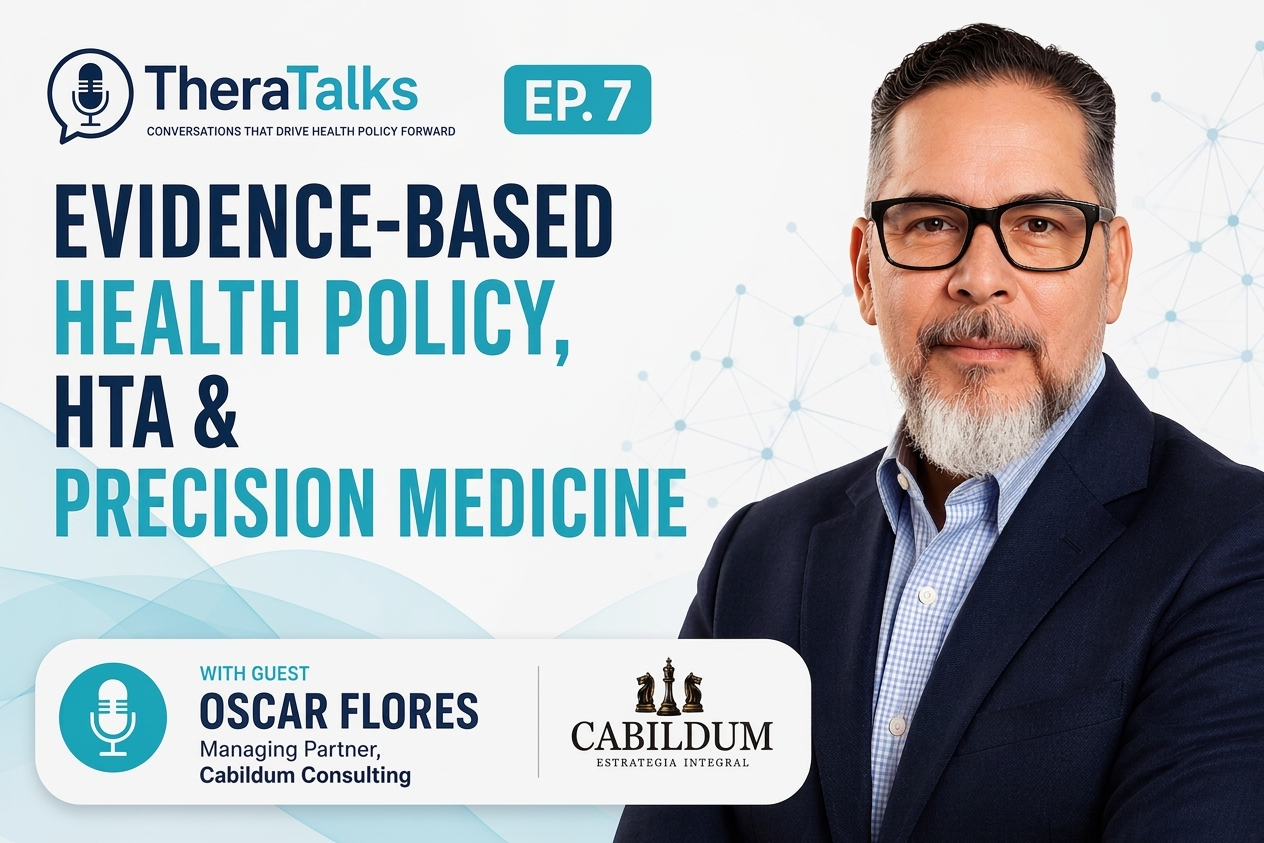
September 11, 2026 – Thera Health Policy & Access is pleased to announce the release of Episode 7 of TheraTalks, the interview series dedicated to engaging healthcare leaders, policymakers, regulators, industry innovators, and thought leaders in meaningful conversations about the issues shaping the future of healthcare in Latin America and beyond.
This latest episode features a conversation between José Luis Cárdenas Tomažič, Founder & Managing Director of Thera Health Policy & Access, and Oscar Flores, Managing Partner of Cabildum Consulting, one of Mexico’s leading health policy consulting firms.
As healthcare systems across Latin America face increasing pressure to improve outcomes while managing constrained resources, the ability to translate scientific evidence into effective public policy has become more important than ever. In this episode, José Luis and Oscar explore how evidence-based decision-making, health technology assessment (HTA), real-world evidence, and precision medicine are transforming the way healthcare systems evaluate innovation and allocate resources.
A central theme of the discussion is the challenge of implementing evidence-based health policy in complex and highly fragmented healthcare systems. Oscar explains that while evidence-based medicine remains the aspiration, decision-makers must also navigate institutional constraints, differences in coverage across healthcare providers, budget limitations, and operational realities that influence the availability of treatments and healthcare services.
The conversation examines the evolution of health technology assessment (HTA) in Mexico, from relatively simple economic analyses to more sophisticated methodologies incorporating cost-effectiveness, cost-utility, and value-based frameworks. Oscar describes how Mexico’s HTA ecosystem has matured over the past two decades, providing a stronger foundation for evaluating healthcare technologies and supporting more informed policy decisions.
Another important topic explored is the distinction between ex ante and ex post evaluation. While many healthcare decisions rely on clinical trial evidence and projections generated before implementation, José Luis and Oscar discuss the growing importance of evaluating whether healthcare interventions actually achieve their expected results in real-world settings. This shift creates opportunities for greater accountability, improved resource allocation, and a deeper understanding of how innovation performs within healthcare systems.
The discussion also explores the potential role of real-world evidence and outcomes-based agreements. Oscar highlights how healthcare systems are increasingly interested in linking reimbursement and access decisions to measurable outcomes, creating incentives to ensure that innovation delivers meaningful value for patients and society. The speakers review international experiences and discuss the opportunities and challenges associated with implementing these models in Latin America.
A significant portion of the interview focuses on efforts to reduce variation in care through national clinical protocols and integrated care models. Oscar describes initiatives aimed at standardizing treatment pathways and promoting more consistent care delivery across healthcare institutions. Particular attention is given to integrated cardio-renal-metabolic care strategies that seek to address interconnected chronic diseases through coordinated and evidence-based approaches.
The conversation also addresses the growing relevance of precision medicine and molecular diagnostics, particularly in oncology. Oscar explains how advances in genomic testing, molecular characterization, and personalized treatment selection may help improve clinical outcomes while allowing healthcare systems to allocate resources more effectively. As these technologies continue to evolve, policymakers and healthcare leaders will increasingly face important questions regarding access, reimbursement, implementation, and regulation.
Looking toward the future, José Luis and Oscar discuss how digital health, interoperability, and artificial intelligence could strengthen healthcare decision-making. They examine the potential of integrated data systems to generate better evidence, support policy evaluation, improve care coordination, and help healthcare systems learn continuously from patient outcomes.
The interview also highlights the importance of prevention and long-term health policy planning. Oscar argues that many of the most pressing health challenges facing Latin America, including chronic diseases and their complications, require sustained interventions that extend beyond electoral cycles and involve coordinated action across multiple sectors of government and society.
Reflecting on the discussion, José Luis emphasized the importance of connecting evidence generation with real-world impact.
“Healthcare systems generate enormous amounts of evidence, but the ultimate goal is not producing more information. The goal is converting knowledge into better decisions, better policies, and better health outcomes for patients. As innovation accelerates, the ability to evaluate what works in real-world settings will become increasingly important for governments, healthcare systems, and life sciences organizations alike,” said José Luis Cárdenas Tomažič.
Watch TheraTalks Episode 7:
Watch on YouTube
Oscar Flores serves as Managing Partner of Cabildum Consulting, one of Mexico’s leading health policy consulting firms. His work focuses on health policy, health technology assessment, market access, healthcare system reform, evidence-based decision-making, and healthcare innovation. Throughout his career, he has collaborated with public institutions, industry stakeholders, healthcare organizations, and international partners to strengthen healthcare policy development and improve access to health technologies across Latin America.
Thera Health Policy & Access is a specialized consultancy and Think & Do Tank focused on health policy, market access, healthcare regulation, public affairs, strategic intelligence, and healthcare system transformation. Through evidence-based analysis, stakeholder engagement, and multidisciplinary expertise, Thera supports organizations in navigating complex healthcare environments and advancing sustainable solutions that improve patient access and health outcomes.